
Guide · Lyophilization Formulation
Cryoprotectant and lyoprotectant screening for lyophilized diagnostic assays
A practical guide to excipient screening in freeze-dried assay development — why selection matters, what a good panel looks like, and how a preselected 96-well plate consolidates weeks of work into a single experiment.
Selecting the right cryoprotectants and lyoprotectants for a lyophilized diagnostic assay is one of the most time-consuming and uncertain steps in lyo formulation development. The wrong excipient combination causes enzyme denaturation, poor cake structure, or failed reconstitution. The right one gives you a stable, shelf-ready formulation — but finding it requires systematic screening across a panel of candidates. EVIK™ Excipient Selection Plates are built to make that screening faster, more reproducible, and more likely to succeed.
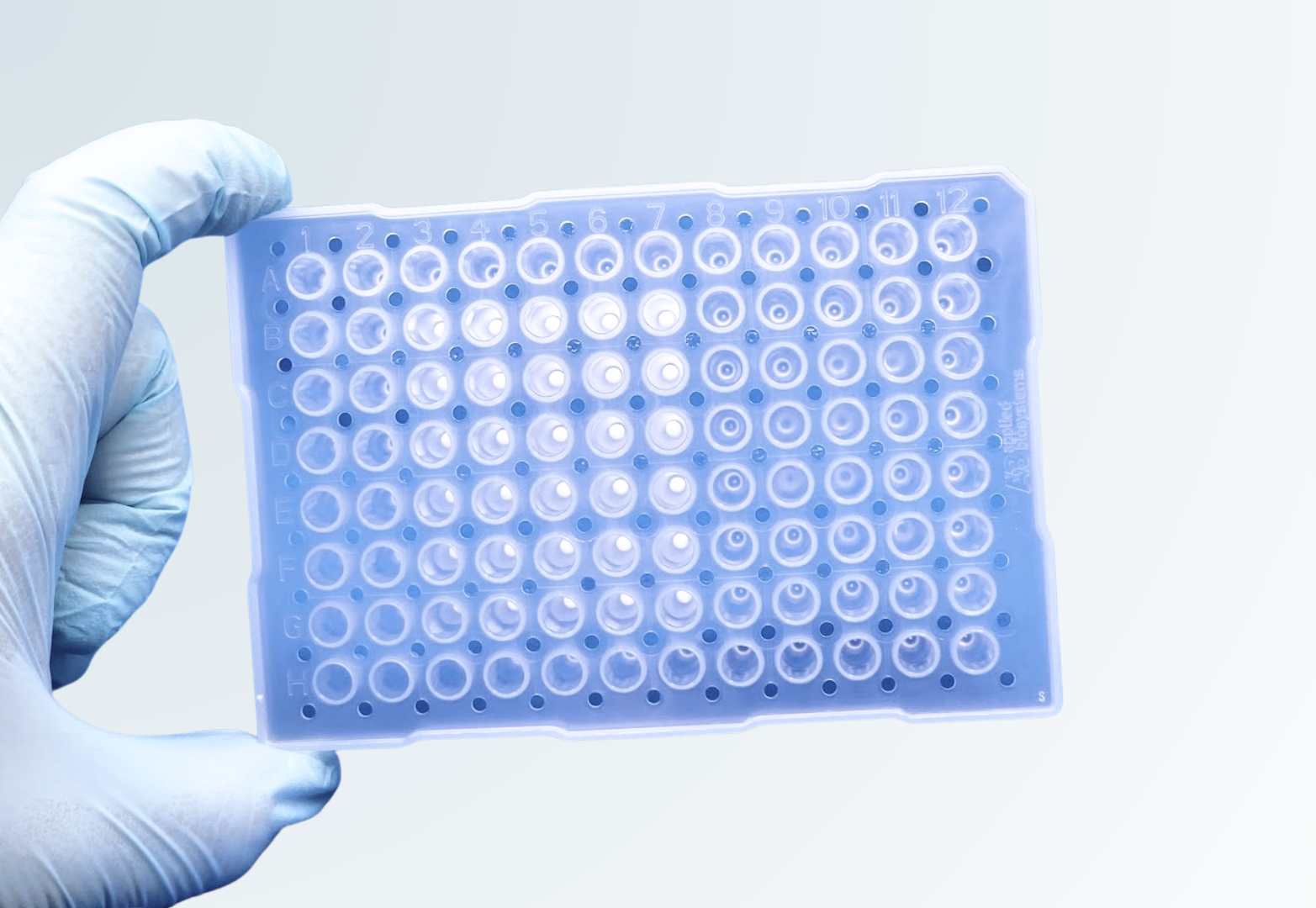
EVIK™ Excipient Selection Plates are 96-well plates pre-filled with lyophilized excipients — cryoprotectants, lyoprotectants, stabilizers, buffers, and surfactants — curated and preselected by Evik Diagnostics based on multiple years of expertise in stabilizing molecular diagnostic enzymes in freeze-dried formulation.
Each well contains a ready-to-use lyophilized excipient. Simply reconstitute each well with 20 µL of your reagent and run the plate in a standard thermal cycler. The result is a systematic, reproducible excipient compatibility screen across an entire curated panel — in a single experiment.
What is an EVIK™ Excipient Selection Plate?
Cryoprotectants and lyoprotectants are the excipients that protect biological molecules — enzymes, antibodies, nucleic acids — from the physical and chemical stresses of the freeze-drying process. Without the right excipient, lyophilization causes irreversible protein denaturation, loss of enzymatic activity, or aggregation that cannot be recovered on reconstitution.
The challenge is that no single cryoprotectant or lyoprotectant works for every reagent. Sucrose and trehalose are the most commonly used, but the optimal concentration, combination, and ratio depends on the specific enzyme, buffer system, and assay chemistry. Surfactants, amino acids, and polymers may also play a stabilising role — or introduce compatibility problems of their own.
This means that lyophilization cycle development always begins with excipient screening — a systematic comparison of candidate formulations to identify which combination delivers the best balance of stability, activity, and reconstitution performance. Done manually, this is slow and resource-intensive. Done with an EVIK™ Excipient Selection Plate, it is a single experiment.
Why cryoprotectant and lyoprotectant selection matters
What's in the plate
Each EVIK™ Excipient Selection Plate contains a preselected panel of excipients chosen by Evik Diagnostics to give researchers the best chance of identifying a stable lyophilized formulation for their assay. The panel covers the major excipient classes used in lyophilization formulation development:
Cryoprotectants and lyoprotectants — saccharides including sucrose and trehalose at multiple concentrations.
Stabilizers — amino acids, polymers, and protein stabilisers known to protect enzyme activity through freeze-drying.
Buffers — a range of pH 5–7 buffer systems to support excipient compatibility screening across different assay chemistries.
Surfactants — non-ionic surfactants for reconstitution and compatibility screening.
Custom plate configurations, excipient combinations, ratios, and full factorial designs are available on request. Contact our teamto discuss your formulation requirements.
Compatible assay types
EVIK™ Excipient Selection Plates are designed for use with a wide range of molecular diagnostic and immunoassay formats. The preselected excipient panel has been curated to support formulation screening across:
PCR and qPCR — polymerase chain reaction assay components.
RT-LAMP — reverse transcription loop-mediated isothermal amplification.
CRISPR-based assays — CRISPR-Cas12 and CRISPR-Cas13 diagnostic formats.
RPA — recombinase polymerase amplification.
Antigen / antibody and protein assays — immunoassay stabilisation screening.
For potential use with other assay types or components not listed above, contact our lyo expert team.
Ready to use in three steps
Add 20 µL of your reagent directly to each well of the pre-filled lyophilized plate.
01
Reconstitute
02
Run
Place the reconstituted plate in a standard thermal cycler and run your assay protocol.
Compare performance across wells to identify the excipient combination that best stabilises your formulation.
03
Evaluate
About the product range. EVIK™ Excipient Selection Plates are part of the EVIK™ DxSpheres product range, developed by Evik Diagnostics — specialists in preformulated lyobeads and lyophilization formulation for molecular diagnostics.
To request a quote, a datasheet, or to discuss a custom formulation, get in touch with our team.