
Freeze-Dried Skincare Spheres Manufacturer Guide: How to Write Your Spec Sheet and RFQ
How to Choose a Freeze-Dried Skincare Spheres Manufacturer
Choosing a freeze-dried skincare spheres manufacturer starts long before the first quote arrives. The clearer your specification, the more accurate the quotes, the fewer the surprises during development and the faster you can reach a product ready for launch.
This guide gives you the practical tools to do that: a specification sheet, an RFQ template, a framework for comparing quotes and a protocol for evaluating samples. Examples from our EVIK™ LyoPearl range show what real skincare sphere specifications look like.
Ready to brief your project?
Send us your request for quotation (RFQ) or email info@evikdiagnostics.com. Our team can help you identify a suitable starting specification for your application.
Before You Send an RFQ: Test a Standard Sphere First
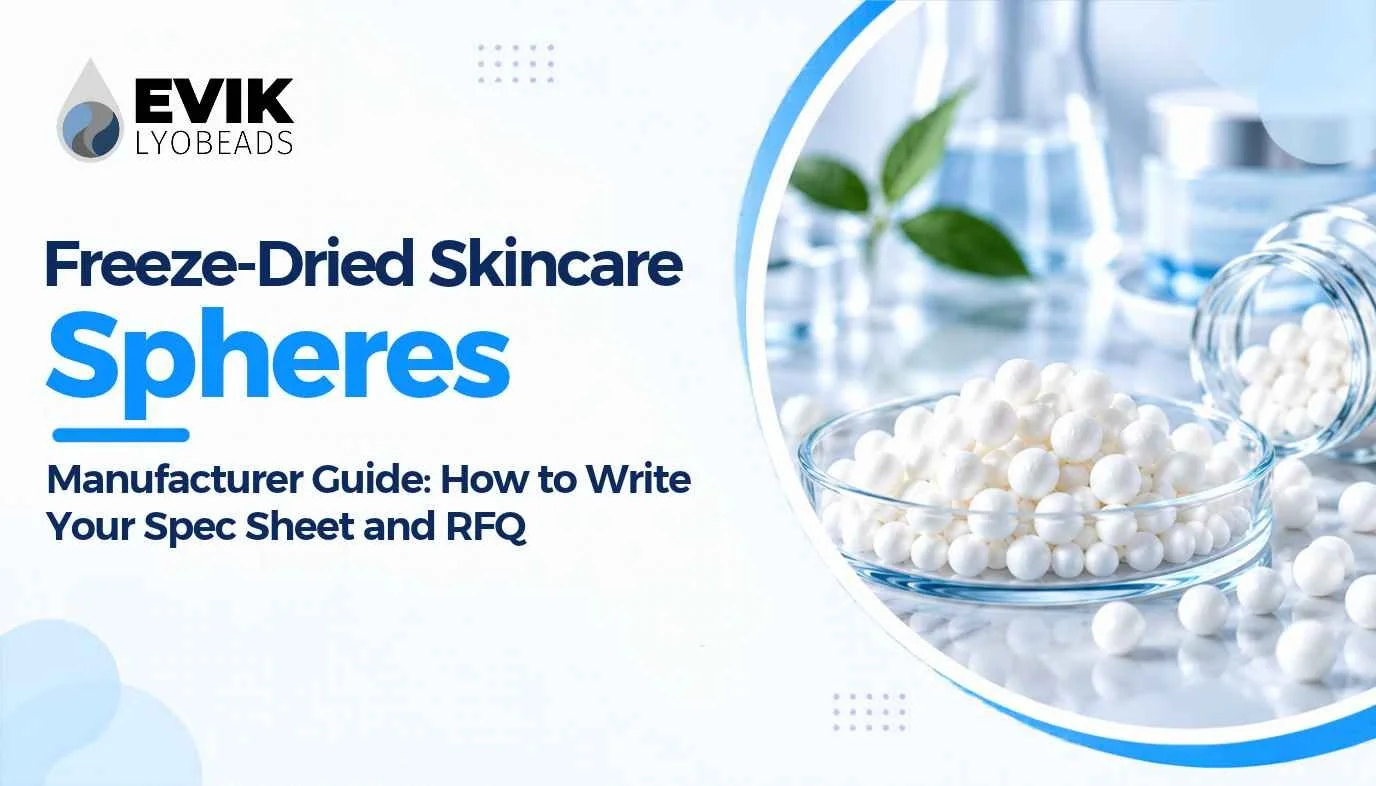
Freeze-dried skincare spheres, often called beads or lyobeads, are dry spheres designed to hold a measured amount of active ingredients and dissolve in water or a suitable activator. If you have never worked with this format, handling a real sample is a practical first step toward developing a meaningful specification.
Our five standard EVIK™ LyoPearl beads are available as research and evaluation samples. Each demonstrates a different way to specify an active ingredient.
| Standard Bead | How Its Active Is Specified |
|---|---|
| LyoPearl Ascorbic Acid (Vitamin C) | L-ascorbic acid at 82.7% of dry weight, with sodium hyaluronate and hydrolyzed collagen. |
| LyoPearl Retinol (Vitamin A) | Retinol at 22.7% of dry weight, with sodium hyaluronate and polysorbate 20. |
| LyoPearl Niacinamide (Vitamin B3) | 12.8 mg of niacinamide per bead. |
| LyoPearl Hyaluronic Acid | Sodium hyaluronate at 23.1% of dry weight. |
| LyoPearl Collagen | Hydrolyzed collagen at 8.9%, with sodium hyaluronate at 26.0%. |
Test the samples in your intended base or activator and record their dissolution, appearance, texture and compatibility. Use those observations to complete the specification sheet below.
Compare the EVIK™ LyoPearl beads →
The Specification Sheet: What to Tell a Manufacturer
A useful specification defines the formulation, physical characteristics, performance expectations, packaging and production volumes. The following table provides a starting point for your project brief.
| Parameter | What to Specify | Real-World Reference |
|---|---|---|
| Active ingredient(s) | Name, grade, purity and any preferred supplier. | Sodium hyaluronate can be specified by molecular-weight grade. |
| Active load | Mass per sphere or percentage of dry weight. | 82.7% dry weight for the Vitamin C bead; 12.8 mg per niacinamide bead. |
| Sphere mass | Target dry mass per sphere and acceptable range. | 3.1 mg for the hyaluronic acid bead; 4.2 mg for the Vitamin C bead. |
| Dose consistency | Allowable variation between individual spheres. | Our beads typically vary by less than 2%, according to our stated specification. |
| Excipient system | Lyoprotectants, stabilizers and ingredients to include or exclude. | Selected for each active to protect potency and control dissolution. |
| Dissolution | Required liquid, mixing conditions and target dissolution time. | Our beads are designed to dissolve within seconds in water or a suitable activator. |
| Appearance | Color, shape, surface quality and acceptable variation. | Vitamin C beads should be white to off-white; yellowing may indicate oxidation. |
| Fill and packaging | Number of spheres per container, container type and desiccant requirements. | Our standard format is 10 beads per vial, stored with a desiccant pouch. |
| Storage | Required temperature, humidity and light conditions. | Define conditions based on the formulation and validated product requirements. |
| Batch testing | Tests and acceptance criteria required for every batch. | Bead mass, diameter, moisture content and active concentration. |
| Volumes | Evaluation samples, proof-of-concept, pilot and annual quantities. | Volume forecasts help determine pricing, lead times and scale-up planning. |
If molecular weight matters for your formulation, read our guide to hyaluronic acid in skincare to understand why it can influence product performance.
Not sure how to complete your specification?
Share your active ingredient, target dose and intended application. Our team can help you identify the key parameters for an initial project brief. Email info@evikdiagnostics.com.
The RFQ Template: Ten Sections to Include
A complete request for quotation helps you obtain comparable responses from different manufacturers. Include the following ten sections in your RFQ.
1. Company and Project Overview
Introduce your company, brand positioning, target customers and intended launch markets.
2. Product Concept
Explain how the sphere will be used, what liquid it should dissolve in and where it fits into the skincare routine.
3. Sphere Specification
Attach your completed specification sheet, including active ingredients, dose, mass, appearance and dissolution targets.
4. Quality Requirements
List required batch tests, certificates, technical documentation and acceptance criteria for each production lot.
5. Packaging and Fill
Define the bead count, container type, desiccant and custom packaging requirements. Raise non-standard formats early.
6. Regulatory Markets
Identify the countries where you plan to sell and the regulatory documentation required to support your product.
7. Production Volumes
Provide quantities for samples, proof-of-concept, pilot production and forecast annual demand.
8. Project Timeline
Specify target dates for sample delivery, formulation approval, pilot production and commercial launch.
9. Commercial Questions
Request pricing tiers, minimum order quantities, lead times, development fees and clear terms for formula ownership.
10. Attachments
Include ingredient specifications, safety data sheets and any existing formulation, packaging or performance requirements.
How to Compare Quotes From Manufacturers
The lowest unit price does not necessarily represent the best overall value. Compare each quote against the same formulation, quality, packaging and delivery requirements.
| Quote Element | What to Look For | What to Watch Out For |
|---|---|---|
| Development work | Feasibility studies, formulation work and production costs itemized separately. | Development expenses hidden in a high unit price. |
| Unit price | Clear pricing per sphere or container, with volume-based tiers. | Pricing based on unconfirmed production volumes. |
| Minimum order quantity | Separate minimums for proof-of-concept, pilot and commercial production. | A single MOQ applied to every development phase. |
| Lead times | Timelines for samples, development, pilot runs and commercial supply. | A single delivery date without intermediate milestones. |
| Batch testing | Defined tests, acceptance criteria and confirmation of what is included. | Essential quality testing quoted as an unexpected extra. |
| Packaging | Specified container, fill count, desiccant and labeling requirements. | Packaging left undefined until late in development. |
| Sample terms | Confirmation that samples represent the intended formulation and production process. | Handmade samples with no demonstrated route to scalable production. |
For a broader view of selecting a development partner, read our guide to the cosmetic CDMO for single-dose lyophilized beads and our article on outsourcing freeze-dried cosmetics.
The Sample Evaluation Protocol
When samples arrive, evaluate them consistently. Use the same conditions for every manufacturer so your results provide a fair basis for comparison.
- Inspect on arrival. Check the seal, packaging integrity and presence of desiccant where applicable. Confirm that the spheres are intact, uniform and the expected color.
- Test dissolution. Use the liquid and quantity intended for your product. Record the time required to dissolve each sphere under consistent conditions.
- Assess feel and finish. For suitable cosmetic evaluation samples, assess texture, residue, spreadability and absorption according to the intended use.
- Check compatibility. Combine the sphere with the intended serum or activator and observe any separation, color changes, clumping or other unexpected behavior.
- Run a storage check. Store sealed samples under the proposed storage conditions and evaluate them at predefined intervals. Use a validated stability protocol for formal product decisions.
- Record and share results. Document the lot, test conditions, observations and deviations. Send clear feedback to the manufacturer to guide the next sample round.
Consistent handling helps keep your evaluation results meaningful. Our guide to lyophilized bead handling covers storage, transfer and practical handling considerations.
Start your evaluation with standard LyoPearl beads.
Request evaluation samples or contact our team at info@evikdiagnostics.com to discuss your requirements.
What to Expect After You Choose a Manufacturer
Once you select a manufacturing partner, the project typically progresses through several stages. The exact sequence depends on formulation complexity, testing requirements and production volumes.
- Evaluation samples. Use standard beads to establish a benchmark for appearance, dissolution and handling.
- Proof-of-concept batches. Develop small batches around your active ingredient and target dose to establish initial feasibility.
- Compatibility assessment. Evaluate the formulation, protective excipients, intended activator and relevant performance requirements.
- Pilot production. Produce a representative batch to evaluate process consistency, packaging and market-testing requirements.
- Commercial-scale manufacturing. Move to the agreed production scale with documented quality controls and batch testing.
How EVIK Responds to Your RFQ
EVIK manufactures and supplies EVIK™ LyoPearl skincare beads. Our process is designed to turn a liquid formulation into a dry, single-dose sphere while protecting the active ingredients through formulation, freeze-drying and packaging.
In our process, each active is formulated with suitable protective excipients. Droplets are frozen in liquid nitrogen at −196°C to form spheres, after which ice is removed under vacuum. The resulting beads are counted into vials under controlled humidity and sealed with desiccant.
Learn more about the process on our technology page.
Our experience includes 15 years of lyophilized reagent bead production, an ISO 13485-certified facility for diagnostic contract manufacturing and processes designed to meet applicable Good Manufacturing Practice standards. Quality and regulatory requirements for a specific cosmetic project should be confirmed during project scoping.
Explore our custom cosmetic bead manufacturing capabilities or learn more about the features of lyophilized beads.
Frequently Asked Questions
What does a freeze-dried skincare spheres manufacturer need to quote accurately?
At minimum, provide your active ingredient, target dose per sphere and intended application. A completed specification sheet, packaging requirements and forecast production volumes help the manufacturer prepare a more precise quote.
What should a freeze-dried sphere specification sheet include?
Include the active ingredients and their grades, active load, target sphere mass, allowable variation, excipient requirements, dissolution target, appearance, packaging, storage conditions, batch tests and production volumes.
How consistent should the dose be from sphere to sphere?
Ask each manufacturer to define its typical mass variation, measurement method and acceptance criteria. EVIK's stated typical variation for its beads is below 2%; confirm the applicable specification and dose-uniformity requirements for your project.
Can I test standard spheres before writing a custom specification?
Yes. Evaluation samples of all five standard EVIK™ LyoPearl beads are available for research and evaluation. Testing standard formats can help establish your preferred dose, dissolution behavior and packaging requirements.
What should be tested in every batch?
Potential tests include sphere mass, diameter, moisture content and active concentration. The appropriate test panel and acceptance criteria depend on the formulation, intended use and agreed quality specification.
How are freeze-dried skincare spheres packaged?
EVIK's standard LyoPearl format is 10 beads per vial, with desiccant protection as specified for the packaging. Alternative bead counts and containers can be discussed during project scoping.
How do I compare different manufacturers fairly?
Give every manufacturer the same specification, volume forecast, packaging requirements and timeline. Compare development fees, unit prices, MOQs, lead times, testing, documentation and sample scalability rather than comparing unit prices alone.
Can a manufacturer customize the active ingredient and dose?
Custom formulation feasibility depends on the ingredient's stability, compatibility with the excipient system, target loading and freeze-drying process. Share your active, dose and intended application so the manufacturer can assess feasibility.
How long does it take to develop a custom freeze-dried sphere?
Timing depends on formulation complexity, raw material availability, sample iterations, stability testing, packaging and production scale. Ask for separate milestones for feasibility, samples, pilot production and commercial supply.
Send Your Specification to EVIK™ LyoPearl
A clear specification and RFQ turn a product concept into a project that manufacturers can evaluate and quote. Start with standard evaluation samples, complete your specification, request comparable quotes and assess the results before committing to commercial production.
When you are ready, send us:
- Your completed specification sheet, or your active ingredient, target dose and intended use
- Your packaging, bead count and fill requirements
- Your expected sample, pilot and commercial volumes
- Your target development and launch timeline
- Any quality, testing or regulatory documentation requirements
Email your RFQ to info@evikdiagnostics.com to request evaluation samples and discuss a starting specification.