
What Is Lyophilized Powder? How It Is Made, Where It Is Used and When Beads Work Better
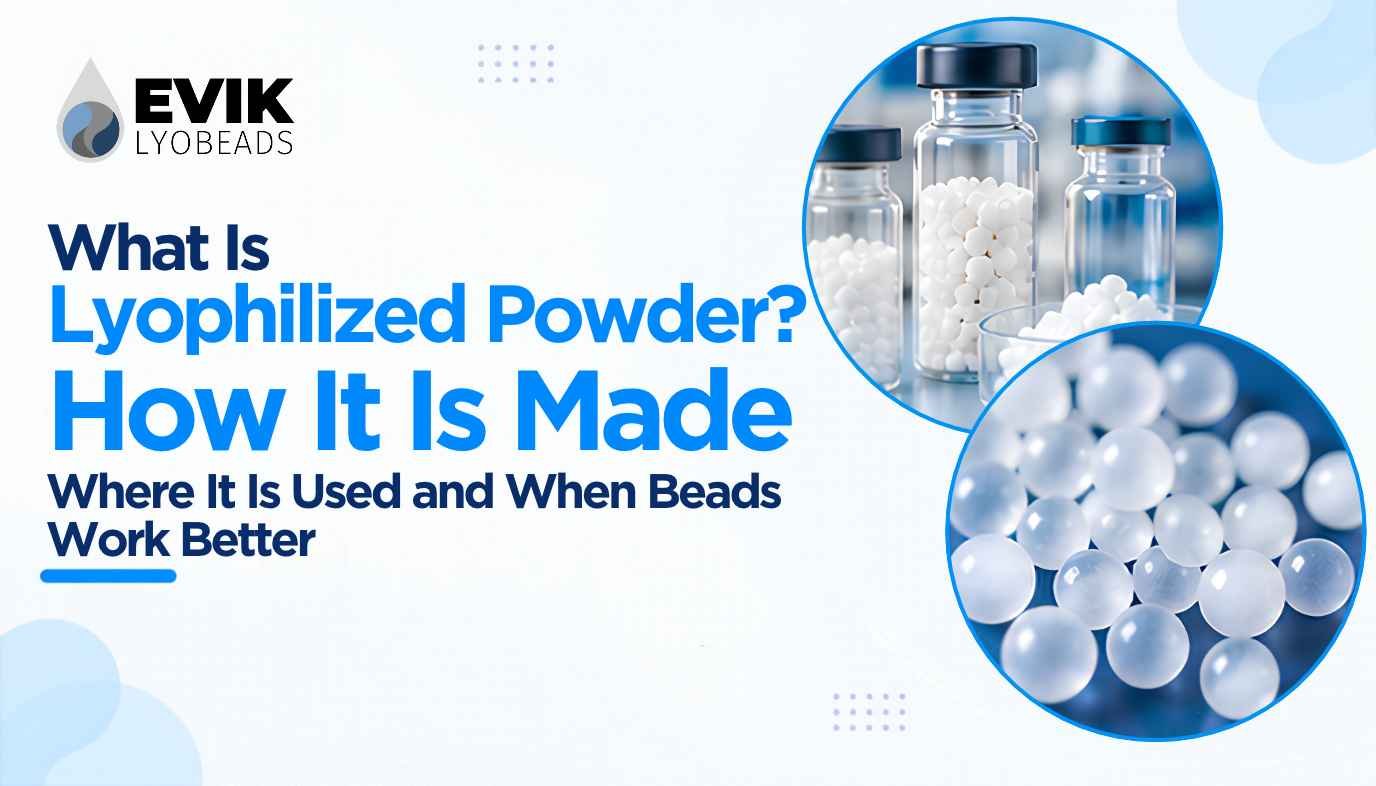
What Is Lyophilized Powder? A Complete Guide to Freeze-Dried Products
Lyophilized powder is a product that has been freeze-dried: frozen, then dried under vacuum so the ice turns straight to vapor, leaving a dry, porous solid that dissolves again when you add liquid. Because most of the water is gone, a lyophilized product can stay stable far longer than its liquid form, often without a freezer.
You will find freeze-dried products in medicine vials, diagnostic kits, research reagents and, increasingly, skincare. At EVIK, we freeze-dry formulas into beads rather than loose powder, so this guide also explains when a bead is the better format.
Looking for a better format for your formulation?
Explore our freeze-dried bead technologies or email info@evikdiagnostics.com to discuss your project.
What Does "Lyophilized" Mean?
Lyophilization and freeze-drying are the same process. The finished material is sometimes called a lyophilisate or lyophile, and it is often described as a "powder" even when it sits in a vial as a solid, sponge-like cake.
What matters is that the water has been removed at low temperature instead of being boiled or evaporated off, which protects sensitive ingredients such as proteins and enzymes.
Freeze-Drying
The product is frozen before moisture is removed under controlled vacuum conditions.
Sublimation
Ice changes directly into vapor without passing through the liquid phase.
Dry Porous Structure
The finished product has a porous structure that allows liquid to enter during reconstitution.
Improved Stability
Removing most of the water can significantly slow degradation reactions in sensitive formulations.
How Lyophilized Powder Is Made
Freeze-drying runs in three main stages. Each stage has to be carefully controlled to protect the product's structure and functionality.
01. Freezing
The liquid formula is cooled until pure ice crystals form, concentrating the other ingredients between them. The freezing rate shapes the final structure: slower freezing gives larger ice crystals and a coarser, more open solid.
02. Primary Drying
Under vacuum, gentle heat makes the ice turn directly into vapor without melting. This process is called sublimation and removes most of the water from the frozen product.
03. Secondary Drying
The temperature is raised to drive off the water still bound to the solid, bringing the product down to its target residual moisture.
Temperature Control
Throughout the cycle, the product has to stay below its collapse temperature. If it gets too warm, the porous structure collapses, which can slow reconstitution and affect potency.
The Role of Excipients in Lyophilized Products
Lyophilized products are rarely just the active ingredient. Formulators add excipients to protect the active during freezing, drying and reconstitution while maintaining the structure and performance of the finished product.
| Excipient Type | Common Examples | What It Does |
|---|---|---|
| Cryo- and Lyoprotectants | Sucrose, Trehalose | Protect proteins during freezing and drying by forming a glassy matrix. |
| Bulking Agents | Mannitol | Give the dried product structure and an even appearance. |
| Surfactants | Polysorbate 20 or 80 | Reduce aggregation at surfaces during freezing, drying and reconstitution. |
| Buffers | Phosphate, Histidine, Tris | Help maintain stable pH conditions throughout formulation and reconstitution. |
Choosing the right combination is often the hardest part of development. Our EVIK™ Excipient Selection Plates let molecular diagnostic developers screen buffers, stabilizers and surfactants in a 96-well format before committing to a formulation.
Why Products Are Lyophilized
Freeze-drying offers several advantages across pharmaceutical, diagnostic, research and cosmetic applications.
Long-Term Stability
With most of the water removed, the reactions that degrade sensitive ingredients can slow dramatically.
Simpler Storage and Shipping
Many lyophilized products can be stored at room temperature or in a refrigerator rather than a freezer, potentially removing the need for dry ice.
Lighter, Smaller Shipments
Removing water reduces product weight and can make transportation and storage more efficient.
Fast Reconstitution
The porous structure allows liquid to flow in quickly, helping the product dissolve readily.
Protection for Sensitive Ingredients
Controlled low-temperature drying can help avoid the heat damage associated with some other drying methods.
Flexible Applications
Lyophilization can be used to develop dry formulations for pharmaceutical, diagnostic, research and skincare products.
One important consideration: moisture sensitivity.
A dry, porous product readily absorbs water from the air, so it must be sealed and handled with care. Our guide to lyophilized bead handling covers the same principles.
Where Freeze-Dried Products Are Used
Lyophilization is used across multiple industries, especially where stability, controlled dosing and reconstitution are important.
| Industry | Typical Lyophilized Products |
|---|---|
| Pharmaceuticals | Injectable drugs, biologics, vaccines and antibiotics supplied for reconstitution. |
| Diagnostics | Assay reagents, enzymes, controls and calibrators. |
| Life Science Research | Enzymes, antibodies, peptides and other research reagents. |
| Microbiology and Nutrition | Probiotics and microbial cultures. |
| Food | Instant coffee, dried fruit and other freeze-dried foods. |
| Skincare | Freeze-dried actives such as vitamin C, retinol and hyaluronic acid. |
For diagnostic developers, our guide to the lyophilized assay reagent format explains how liquid assays are converted into dry, room-temperature-stable reagents.
How to Reconstitute Lyophilized Powder
Reconstitution means adding a specified liquid to a freeze-dried product to restore it to a usable solution. Always follow the product's own instructions first. As a general guide, the process includes the following steps.
01. Reach Room Temperature
Let the vial reach room temperature if it has been refrigerated, so condensation does not form when it is opened.
02. Settle the Material
Tap the vial gently so all the material sits at the bottom.
03. Add the Diluent
Add the specified diluent slowly, running it down the inside wall of the vial rather than straight onto the solid.
04. Dissolve Gently
Swirl or roll gently until fully dissolved. Avoid vigorous shaking, which can foam or damage proteins.
05. Inspect the Solution
Check the solution for clarity and particles unless the product instructions specify otherwise.
06. Use as Directed
Use or store it as directed. Once reconstituted, most products are much less stable than in their dry form.
Lyophilized Powder vs Cakes vs Beads
"Lyophilized" describes the process, not the shape. The same freeze-dried formula can be produced in three main formats, each offering different advantages depending on the application.
| Format | How It Is Made | Strengths | Limitations |
|---|---|---|---|
| Cake in a Vial | Liquid is filled into the final vial and freeze-dried there. | One vial equals one dose; reconstituted in place. | Tied to the vial; drying can vary across the freeze-dryer shelf. |
| Bulk or Milled Powder | Dried in bulk, then broken into powder. | Flexible amounts and dispensing quantities. | Must be weighed or dispensed; dust and moisture exposure during handling. |
| Lyophilized Beads | Precise droplets are frozen and dried as individual spheres. | Each bead is a pre-measured dose; free-flowing and easy to count into tubes, plates or cartridges. | Bead size and dose are fixed during development. |
For a deeper look, read lyophilized beads vs cakes, or explore the full list of features of lyophilized beads.
Why We Freeze-Dry Into Beads
Beads keep the advantages of freeze-dried products while reducing the need for weighing, dispensing loose powder and managing some of the variation associated with bulk formats.
At EVIK, this is the format we specialize in across diagnostic and cosmetic applications.
EVIK™ DxSpheres
Lyophilized reagent beads for molecular, immuno and protein assays, including ready-to-use Master Mix Beads for qPCR, RT-qPCR and RT-LAMP.
EVIK™ LyoPearl
Freeze-dried skincare beads holding actives such as vitamin C, retinol, niacinamide, hyaluronic acid and collagen. Evaluation samples are available.
Custom Bead Development
Custom beads built around your formula, from compatibility assessment to commercial manufacturing.
Precision Manufacturing
Our standard beads are made from 5–30 µL droplets and measure 2–4 mm across, depending on the formulation and product specifications.
EVIK Diagnostic Bead Capabilities
Our diagnostic beads offer a shelf life of 24+ months at 15–30°C and reconstitute in under a minute, according to the stated product specifications.
Production runs in an ISO 13485:2016-certified facility with an ultra-low humidity environment. We test residual moisture, bead dimensions, mechanical properties and functionality as part of our quality approach.
If you are considering developing freeze-dried beads for your own product, explore our custom manufacturing capabilities.
Want your formula as a lyophilized bead?
Share your project requirements with our team or email info@evikdiagnostics.com to discuss formulation feasibility and development options.
Frequently Asked Questions
What is lyophilized powder?
It is a freeze-dried product: a formula that has been frozen and then dried under vacuum so the ice sublimates, leaving a dry, porous solid that dissolves again when liquid is added.
Is lyophilized the same as freeze-dried?
Yes. Lyophilization is the technical name for freeze-drying. Both terms describe the process of freezing a product and removing its water through sublimation under vacuum.
Why does lyophilized powder sometimes look like a solid cake?
When a formula is freeze-dried inside its vial, it dries as a single porous block, or cake. It is still a freeze-dried product and dissolves the same way.
How long do freeze-dried products last?
It depends on the formula, packaging and storage conditions, so always check the label. As an example, our lyophilized diagnostic beads offer a shelf life of 24+ months at 15–30°C.
Why must lyophilized products be kept dry?
The dry, porous structure readily absorbs moisture from the air, which can collapse the material and reduce its activity. Appropriate packaging and handling are therefore important.
What is the difference between lyophilized powder and lyophilized beads?
Both are freeze-dried. A powder or cake has to be weighed, dispensed or reconstituted in its vial, while each lyophilized bead is a pre-measured dose that can be counted directly into tubes, plates or cartridges.
From Lyophilized Powder to Ready-to-Use Beads
Freeze-drying is one of the most reliable ways to keep sensitive ingredients stable. If your product needs precise, ready-to-use doses rather than powder to weigh or a cake to reconstitute in a vial, lyophilized beads take the process one step further.
Whether you are developing diagnostic reagents, research formulations or skincare products, selecting the right format is an important part of product development.
Let's Discuss Your Formula
Our team can help you explore suitable bead formats and development possibilities. To help us understand your project, share:
- Your product application and industry
- Your active ingredients or reagent formulation
- Your target dose and bead specifications
- Your storage and stability requirements
- Your expected sampling and production timeline
Contact our Lyo expert team to discuss your requirements, evaluation samples and potential custom development options.