
Guide · Assay Development
Lyophilized qPCR and RT-PCR master mix beads for diagnostic assay development
Why starting with a lyo-validated master mix compresses the timeline from initial assay concept to a shelf-stable diagnostic product — and eliminates the reformulation risk that stalls most lyophilized IVD projects.
Developing a stable, sensitive, and reproducible lyophilized molecular diagnostic assay is one of the most resource-intensive challenges in IVD and point-of-care product development. The formulation decisions made at the start of assay development — particularly the choice of master mix and its compatibility with lyophilization — determine whether the project converges in weeks or drags on for months of enzyme re-selection and assay redevelopment.
A common and costly mistake in lyophilized diagnostic assay development is to develop the assay in liquid format first and address freeze-drying compatibility later. In practice, this approach frequently requires complete enzyme re-selection and assay reformulation at the lyophilization stage — because not all enzymes survive the freeze-drying cycle with their activity intact, and not all liquid-format assay buffers are compatible with lyophilization.
The result is often months of optimisation work discarded, and a project effectively restarting at the point when it should be nearing validation.
The costly mistake in lyophilized assay development
Starting assay development with a formulation that has already been validated for lyophilization eliminates this risk. The enzymes are lyo-friendly, the buffer system is lyo-compatible, and the excipient composition has been selected to protect enzyme activity through the freeze-drying cycle and through long-term ambient storage — from day one.
The measurable advantages of this approach:
Reduced development risk — the lyophilization compatibility problem is solved before assay development begins.
Compressed timelines — months of formulation and lyo process development work reduced to weeks.
Predictable scale-up — a formulation developed on a lyo-validated master mix translates directly to manufacturing-scale lyophilization without reformulation.
Earlier cartridge integration — beads can be integrated into prototype cartridges at the development stage, not only at the validation stage.
Why starting with a lyo-validated master mix matters
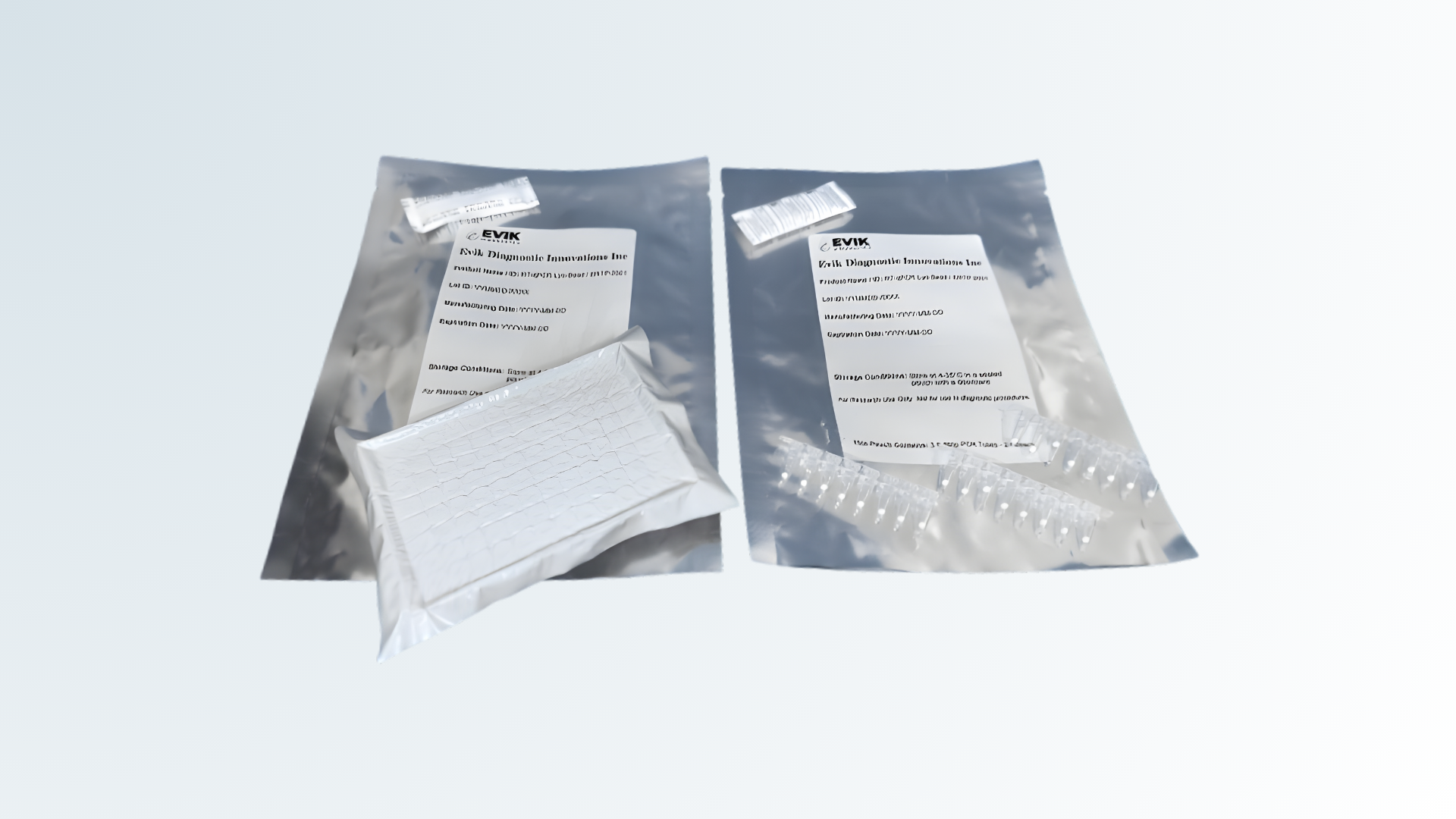
EVIK™ qPCR and RT-PCR DxSpheres are preformulated, lyophilized bead reagents containing all master mix components for a 20 μL reaction — except primers, probes, and template. They are, in other words, blank lyophilized master mix beads: everything you need for the reaction chemistry, ready to accept your assay-specific components.
Each bead is precisely manufactured for a single reaction and contains:
A curated, lyo-friendly DNA polymerase, or a reverse transcriptase plus DNA polymerase combination for RT-PCR.
An optimised reaction buffer system selected for lyo compatibility.
dNTPs at assay-ready concentrations.
Proprietary lyophilization excipients that preserve enzyme activity, maintain bead integrity, and support instant reconstitution.
Each bead reconstitutes in seconds on addition of an aqueous solution. Simply add your primers, probe, and sample and run on a standard thermal cycler. No liquid master mix handling, no cold chain, no on-site reagent preparation.
What EVIK™ DxSpheres are
EVIK™ DxSpheres provide a validated formulation starting point — a proven lyo-compatible master mix foundation from which assay-specific optimisation proceeds. They are not a finished assay, and they are not intended to replace assay development.
Every diagnostic assay target is different. Primer and probe design, concentrations, and hybridisation conditions; sample matrix effects; reaction kinetics; sensitivity and specificity thresholds — all of these must be optimised for the specific target and the specific sample type the assay is designed to detect. This is standard practice, and it applies equally whether the starting point is a liquid master mix or a lyophilized bead.
What EVIK™ DxSpheres change is where that optimisation starts. Instead of beginning with an untested liquid formulation and discovering at the lyophilization stage that the enzymes are not lyo-compatible, development begins with a formulation that has already been validated for lyophilization stability, bead integrity, and ambient-temperature storage — so optimisation effort goes entirely into assay performance, not into solving formulation and lyo process problems.
The result is a shorter, more predictable development pathway from initial assay concept to a validated, shelf-stable lyophilized diagnostic product.
A validated starting point, not a finished assay
Technical specifications
For custom formulation requirements, including specific enzyme sources, cartridge material compatibility, or fully assembled assay beads, contact the Evik Diagnostics team to discuss your assay development project.
Supported assay formats
Lyophilized master mix beads are available in formulations supporting the following molecular diagnostic assay formats:
qPCR (DNA detection) — probe-based quantitative PCR for DNA targets.
RT-qPCR / one-step RT-PCR — combined reverse transcription and PCR for RNA targets in a single tube.
Two-step RT-PCR — separate RT and PCR steps, for applications requiring greater sensitivity or flexibility.
Multiplex PCR — simultaneous detection of multiple targets in a single reaction.
POC and cartridge-based formats — compatible with pre-loading into sealed microfluidic cartridges and lateral-flow integrated systems.
Customisation options
EVIK™ DxSpheres are highly customisable to fit specific assay development requirements. Common customisation routes:
Custom dNTP / Mg²⁺ ratio — options that can improve Ct values and analytical sensitivity.
Custom reaction volume — standard 20 μL format; alternative volumes available on request.
Custom packaging format — 8-strip tubes, 96-well plates, bulk lyophilization, or cartridge-integrated formats.
Custom excipient formulation — for specific matrix compatibility requirements or cartridge material compatibility constraints.
Primers and probes included — fully assembled assay beads containing primers, probe, and master mix components are available for validated assay formats.
About the product range. EVIK™ qPCR and RT-PCR DxSpheres are part of the EVIK™ DxSpheres product range, developed by Evik Diagnostics — specialists in preformulated lyobeads and lyophilized assay development for molecular diagnostics.
To request a quote, a datasheet, or to discuss a custom formulation, get in touch with our team.
Single-bead per reaction, lyophilized (freeze-dried)
Format
20 μL (standard); alternative volumes on request
Reaction volume
DNA polymerase (qPCR) or reverse transcriptase + DNA polymerase (RT-qPCR / RT-PCR); reaction buffer; dNTPs; lyophilization excipients
Components included
Primers, probes, template (sample)
Components not included
Reconstitution
Instant — add aqueous solution directly to bead
qPCR, RT-qPCR, one-step RT-PCR, two-step RT-PCR, multiplex PCR
Compatible assay types
Detection chemistry
Probe-based (TaqMan-style hydrolysis probes)
Thermal cycler compatibility
Standard qPCR thermal cyclers — no specialist equipment required
Storage
Ambient temperature — no cold chain required
Shelf life
12–24 months at ambient (product-specific data available on request)
Formats available
8-strip PCR tubes, 96-well plates, custom formats, cartridge-compatible options