
Bulk Lyophilization Services: Tray-Dried Powder or Bulk Lyophilized Beads?
Bulk Lyophilization Services: Freeze-Drying at Volume
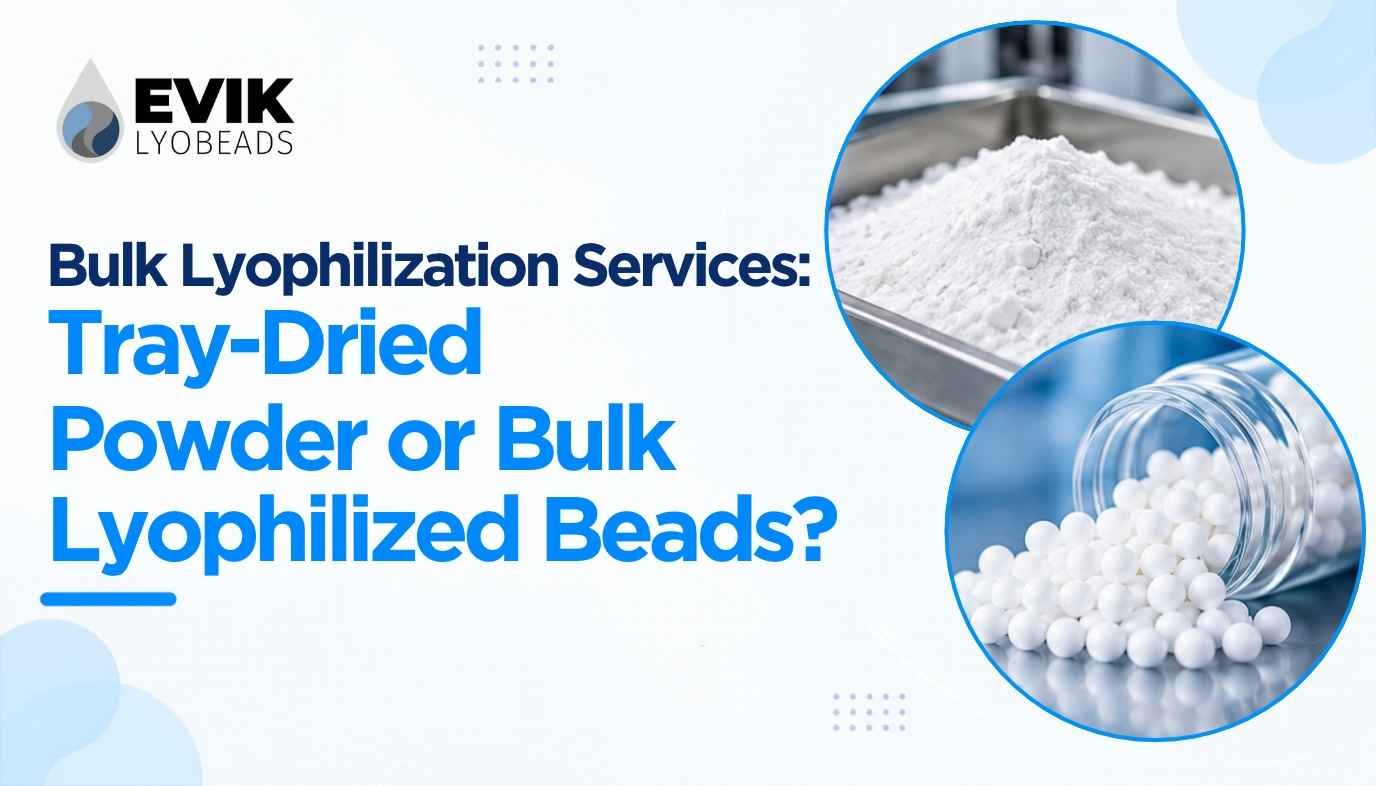
Bulk lyophilization services freeze-dry product at volume, before it is divided into final doses. For many buyers, the real question is not just who will do the freeze-drying, but which bulk format will be easiest to use downstream: a tray-dried powder that still has to be milled and dispensed, or bulk lyophilized beads that arrive already divided into precise doses.
At Evik, we specialize in the second option. This guide explains both approaches, the trade-offs between them and what to look for in a provider, so you can choose the format that fits your process.
Scoping a bulk freeze-drying project?
Email info@evikdiagnostics.com or contact our Lyo expert team to discuss your requirements.
What Are Bulk Lyophilization Services?
Bulk lyophilization means freeze-drying a large quantity of product in bulk rather than in its final dose containers. It is commonly used for active pharmaceutical ingredients, drug intermediates, nutritional and diagnostic materials, and reagents that will be processed, filled or assembled later.
The term covers two very different outputs:
- Bulk powder: Usually dried as a cake in trays and then broken down.
- Bulk lyophilized beads: The formula is frozen as individual droplets and dried as free-flowing spheres, each one a fixed dose.
If you are new to the terminology, our guide to what lyophilized powder is covers the basics.
How Traditional Bulk Tray Lyophilization Works
Traditional bulk tray lyophilization typically follows six steps:
- Fill the trays. The liquid product is poured into stainless steel or disposable trays.
- Load the freeze-dryer. Trays are placed on the dryer shelves, which supply heat during drying.
- Run the cycle. The product is frozen, the ice is removed under vacuum, and bound water is driven off in secondary drying.
- Harvest. The dried product is removed from the trays, often as a solid cake.
- Mill. The cake is broken down into a powder with a more uniform particle size.
- Package and fill. The powder is packed in bulk, then later weighed or dispensed into final containers.
The Challenges of Bulk Lyophilized Powder
Tray-dried bulk powder works well for many products, especially those that will be processed further. It does bring some well-known challenges:
Extra Steps After Drying
Drying a large mass usually produces a cake that has to be harvested and milled before it can be used.
Poor Powder Flow
Freeze-dried powders tend to be cohesive, which makes them harder to convey and dispense.
Dose Control
Powder filling is less mature than liquid filling, and the amount of powder in each container can be difficult to measure and control.
Moisture Exposure
Every harvesting, milling and filling step is another chance for a hygroscopic powder to pick up water.
Handling Risk
Moving trays in and out of the dryer adds handling time and the risk of spills.
Bulk Lyophilized Beads: A Pre-Dosed Alternative
Bulk lyophilized beads avoid most of those post-drying steps. Instead of drying one large mass, the formula is dispensed as precise droplets that are frozen and dried individually. Each bead leaves the dryer as a finished, uniform dose.
| Factor | Tray-Dried Bulk Powder | Bulk Lyophilized Beads |
|---|---|---|
| Form after drying | A cake that is harvested and milled | Individual, free-flowing spheres |
| How doses are created | Powder is weighed or dispensed later | Each bead is already one dose |
| Flow and handling | Often cohesive and dusty | Free-flowing; counted rather than weighed |
| Post-drying steps | Harvest, mill, then fill | Count, then pack or assemble |
| Moisture exposure points | Harvesting, milling and filling | Fewer handling steps after drying |
| Downstream use | Further processing, compounding or powder filling | Direct placement into tubes, plates, cartridges or vials |
| Best for | APIs and intermediates destined for further processing | Ready-to-use doses for assays, devices, kits and skincare |
For a related comparison of cakes and beads, see lyophilized beads vs cakes, and for the wider benefits of the bead format, read the features of lyophilized beads.
What to Look for in Bulk Lyophilization Services
Whichever format you choose, ask every provider these questions:
| Question to Ask | Why It Matters |
|---|---|
| Can you develop the formulation and cycle, not just run it? | Excipients and cycle settings decide stability and yield. |
| What volumes can you produce, and can you scale? | You need a partner for both pilot and commercial supply. |
| How do you control moisture during production and packing? | Lyophilized material readily absorbs water from the air. |
| What is tested on every batch? | Residual moisture, size and function should be documented. |
| How is bulk product packed? | Moisture-barrier packaging with desiccant protects stability. |
| What quality system do you run? | Certification and traceability support your own quality requirements. |
| Have you worked with materials like mine? | Light-sensitive, temperature-sensitive or viscous materials need experience. |
Evik's Bulk Lyophilization Services for Beads
Our bulk lyophilization services are built around lyobeads rather than tray-dried powder:
Scalable Capacity
Our modular production equipment produces from 1,000 to 300,000 lyobeads per day, for large and small batches.
Bulk or Assembled Supply
We supply beads in bulk for your own assembly, or place them into vials, tubes, microwell plates and microfluidic or biosensor cartridges.
Moisture-Controlled Production
Our ISO 13485:2016-certified facility operates under GMP, with an ultra-low humidity environment that keeps residual moisture low. Bulk beads are packed in foil pouches with desiccant.
Tested Batches
We test residual moisture, bead dimensions, mechanical properties and function, with batch-to-batch reproducibility, complete traceability and a zero-tolerance approach to contamination.
Experience with Difficult Materials
Including light-sensitive, temperature-sensitive and viscous components and microparticle suspensions.
Full Development Path
Lyophilization compatibility assessment, prototype development, process optimization and validation, and technology transfer to production.
Our standard beads are made from 5–30 µL droplets and measure 2–4 mm across. For diagnostics, browse EVIK™ DxSpheres and our ready-to-use Master Mix Beads, or request a custom packaging quote from 960 beads.
Need bulk lyobeads at volume?
Send us your project details or email info@evikdiagnostics.com with your target volumes.
Frequently Asked Questions
What are bulk lyophilization services?
They are services that freeze-dry product in bulk rather than in final dose containers. The output is usually either a tray-dried powder or bulk lyophilized beads.
What is the difference between bulk and vial lyophilization?
Vial lyophilization dries the product in its final container, one dose per vial. Bulk lyophilization dries a larger quantity that is divided, filled or assembled afterward.
Does bulk lyophilized product need milling?
Tray-dried bulk product usually forms a cake that is milled into powder. Lyophilized beads do not need milling, because each bead is formed and dried as an individual dose.
Can lyophilized beads be supplied in bulk?
Yes. We supply lyobeads in bulk for in-house assembly, packed in foil pouches with desiccant, or assembled into vials, tubes, plates and cartridges.
Do you offer tray-dried bulk powder lyophilization?
We specialize in lyophilized beads. If your process currently uses tray-dried powder, talk to us about whether a bead format could replace the milling and powder-filling steps.
How many beads can you produce?
Our production capacity ranges from 1,000 to 300,000 lyobeads per day, depending on the project.
Choosing the Right Bulk Lyophilization Services
If your product will be processed or compounded after drying, tray-dried powder from a bulk provider may suit you. If you need ready-to-use doses for assays, devices, kits or skincare, bulk lyophilized beads remove the milling and powder-filling steps and deliver a precise dose every time.
To get a recommendation, send us:
- Your formula or active components
- Target dose per bead and intended use
- Estimated batch and annual volumes
- Bulk or assembled packaging requirements
Discuss Your Bulk Lyophilization Project
Contact our Lyo expert team or email info@evikdiagnostics.com to discuss bulk lyobead production.
Share your formula, target dose, estimated production volumes and packaging requirements so our team can understand your project and recommend a suitable approach.