
Lyophilized Beads vs Cakes: Which Format Fits Your Assay
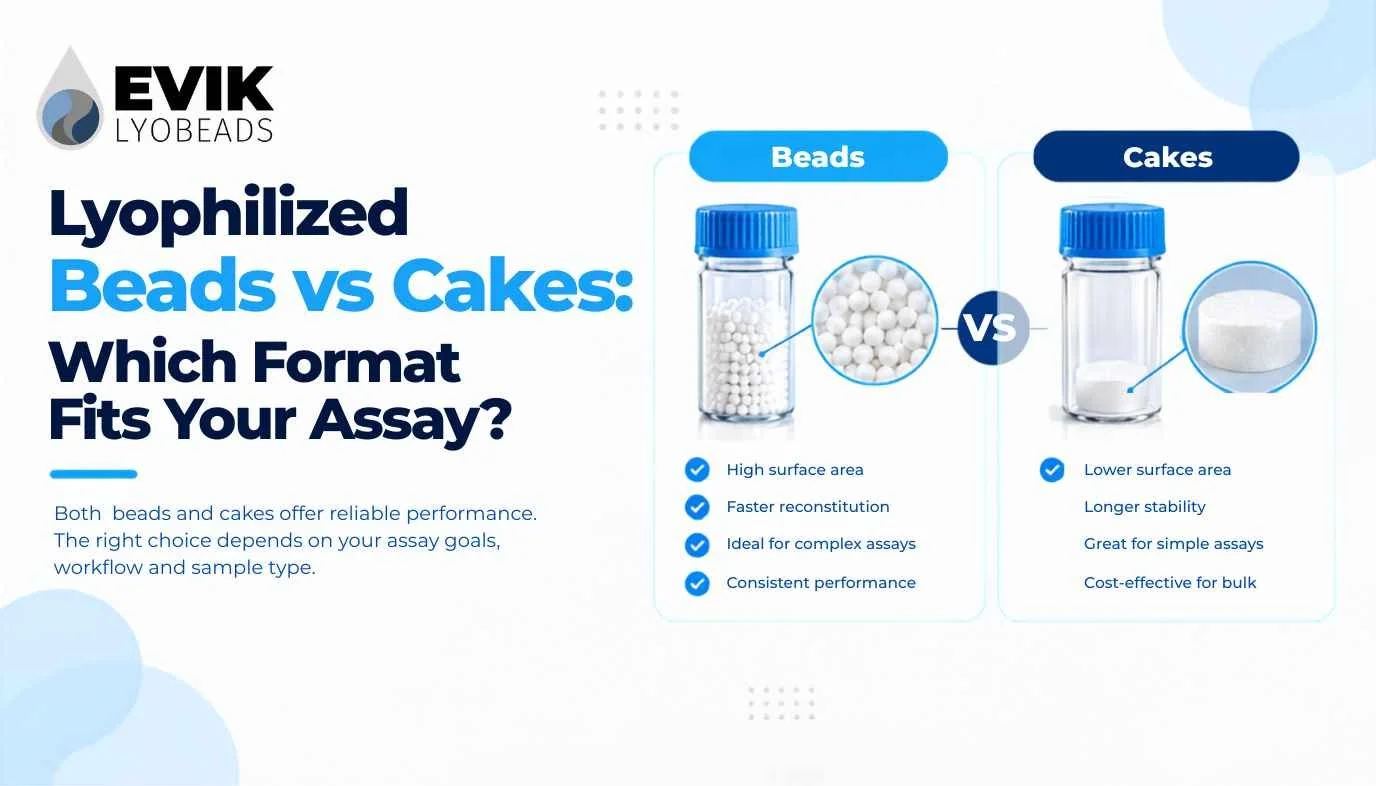
If you are weighing lyophilized beads vs. cakes, the deciding question is where the dried reagent has to end up. A cake is dried inside its final container: a vial, a PCR tube, a plate well, or a cartridge chamber. A bead is frozen as a free droplet, dried in bulk, and placed into its container afterwards.
That single difference drives nearly everything else: cycle development, dose accuracy, where QC happens, and how easily the format drops into a microfluidic device.
The short answer: beads win when the container is small, unusual or expensive, or when several reagents must stay separate until use. Cakes win for larger doses, standard vials, and teams that already run a validated shelf-fill process. Both formats can deliver ambient-stable reagents. The sections below explain where each one breaks.
Two ways to dry the same reagent
Cakes. The liquid reagent is dispensed into the final container, frozen on the freeze-dryer shelf, then taken through primary drying (ice sublimation) and secondary drying (desorption of bound water). The dried matrix takes the shape of the container floor and stays there.
Beads. A precise droplet of reagent is dispensed into liquid nitrogen at −196 °C and freezes almost instantly into a sphere. The frozen spheres are collected onto trays, freeze-dried in bulk, then dispensed into the final container under low humidity. One early patent on this approach describes drying frozen drops for 4 to 24 hours at 50 to 450 mTorr (US 5,998,031).
Bead size follows directly from droplet volume. Assuming a spherical droplet and little shrinkage on drying, the geometry works out as follows:
Droplet volume Approx. bead diameterSurface area10 µL2.7 mm22 mm²20 µL3.4 mm36 mm²25 µL3.6 mm41 mm²50 µL4.6 mm66 mm²
There is a practical ceiling. One sequencing-reagent patent reports that beads of 35 µL and above cracked and broke, and the developers settled on 25 µL as the working size (US 12,559,795). The exact limit depends on solids content and formulation, but the pattern holds: when a dose outgrows one bead, you use two.
How the drying physics differs
In a cake, every molecule of water leaves through the top surface. As the dried layer thickens, its resistance to vapor flow rises, so fill depth largely sets primary drying time. The product must stay below its collapse temperature throughout; common practice is to hold the product 2 to 3 °C below the collapse temperature (Int J Pharm, 2024). Formulations with a low collapse temperature leave very little room to speed the cycle up.
Container geometry adds variation. Vials at the edge of a shelf run warmer than those in the middle. Plastic cartridges conduct heat poorly, and every new cartridge design needs its own cycle. In point-of-care programs, this is where months tend to disappear.
A bead sublimes from its whole surface, and the longest path for vapor is its radius, about 1.7 mm for a 20 µL bead. Drying is fast and largely independent of the container, because there is no container yet.
The trade-off sits in the freezing step. Freezing faster than about 20 °C/min produces small ice crystals and a large ice-liquid interface, which increases surface-induced protein damage (Cao et al., 2003). In one IgG study cited in the literature, immersion in liquid nitrogen gave higher specific surface area and more insoluble aggregates than slow freezing at 2 °C/min (Int J Biol Macromol, 2025). Surfactants reduce this interfacial damage, which is one reason bead formulations are rarely a straight copy of a cake formulation.
Something the field has not settled: most freezing-stress data come from therapeutic proteins. How much liquid nitrogen freezing costs a specific polymerase or reverse transcriptase is poorly documented in public literature, so it has to be measured assay by assay.
Lyophilized beads vs cakes: side-by-side comparison
AttributeLyophilized beadsLyophilized cakes Where drying happens In bulk, before fillingInside the final containerFreezingLiquid nitrogen, very fastShelf-controlled, slowerDose defined byDroplet volume, checked by bead weightFill volume into each containerPractical dose per unitTens of µL; larger doses use several beadsMicrolitres to millilitresQC pointBefore filling: reject off-weight beadsAfter drying, in the containerNew container or cartridgeSame beads, new dispensing stepNew fill and cycle developmentReconstitutionFree-moving, high surface areaDepends on cake density and positionKeeping reagents separateTwo beads in one wellSequential drying or separate chambersFilling environmentLow-humidity room or gloveboxStandard fill before dryingMain physical risksMoisture pickup, static, chipping, crackingCollapse, meltback, shrinkage, skin
Where each format fails
Cakes fail during drying. Collapse and meltback happen when the product warms past its critical temperature or ice is not fully removed (US 11,525,629). Annealing can leave shrinkage, cracks, and a dense skin across the top surface, and in one ramp-rate study it raised dried-layer resistance from 5 to 7.5 cm²·Torr·h/g (source). In a cartridge, a cake pressed into a chamber corner can be bypassed by sample flow and dissolve slowly or unevenly.
Beads fail after drying. A freeze-dried sugar glass is hygroscopic, and a bead has far more exposed surface than a cake. Leave a tray open in ordinary room air and beads soften, stick together, and pick up water that later shortens shelf life. Static makes light beads jump during pick-and-place. Rough handling produces chips and dust, and dust is lost dose.
The failure that catches teams out is packaging. A bead that passes release testing can arrive shrunken and sticky if the pouch seal or desiccant was undersized. Treat the pack as part of the formulation.
Both formats aim for low residual moisture, usually measured by Karl Fischer titration. The bead patent cited above describes beads below 6% residual moisture, preferably below 3%, though the right specification is always product-specific and should be set from stability data.
Choosing a format for your product
Pick beads if your final container is a microfluidic cartridge or custom point-of-care device. You avoid developing a drying cycle around each cartridge revision, and the dryer holds bulk trays instead of bulky plastic parts.
Pick beads if you need a modular kit. A blank master mix bead combined with a separate primer-probe component, or two incompatible reagents in one well, is straightforward with beads and awkward with cakes.
Pick beads if you plan to sell the reagent in several formats. The same lot can be filled into 8-strip tubes, 96-well plates, or custom packs. EVIK™ DxSpheres qPCR master mix beads support 20 µL reactions as standard and are available in these formats (Evik Diagnostics).
Pick cakes if the dose is well beyond what one or two beads carry, the container is a standard glass vial, and you already have a validated fill-and-dry line. Switching formats there adds a humidity-controlled filling step and little else.
If you are moving an existing cake product to beads, do not assume the formulation transfers. The freezing profile is completely different, so re-screen stabilizers and surfactants before scaling. For the broader picture of what the bead format offers, see our overview of lyophilized reagent beads.
Frequently Asked Questions
Are lyophilized beads more stable than lyophilized cakes?
Not inherently. Long-term stability depends on formulation, residual moisture, and packaging. Two products with the same glass composition and moisture content should behave similarly; differences usually trace back to freezing stress or moisture picked up during bead handling.
Can a cake formulation be converted into beads?
Often, but expect rework. Liquid nitrogen freezing creates more ice interface than shelf freezing, so enzyme recovery, surfactant level and solids content all need retesting in the bead format.
How large can a lyophilized bead be?
Most practical beads sit in the tens of microliters. Larger droplets are more prone to cracking during freezing and drying, so larger doses are usually split across two or more beads.
Why do beads need a low-humidity filling environment?
Dried beads are hygroscopic and fully exposed until they are sealed. Filling in a controlled dry room or glovebox, then sealing into foil pouches with desiccant, keeps moisture pickup below the level that would shorten shelf life.
Do beads dissolve faster than cakes?
Generally yes, because a free-moving sphere presents more surface to the rehydration liquid than a cake sitting on a container floor. Actual dissolution time depends on bead size, formulation, and how much the liquid is mixed.
Test the bead format in your own assay Evaluate EVIK DxSpheres against your current liquid or cake reagent, using your primers, probes and instrument. Request a Trial Set